
Indian stock markets tumbled sharply with the Sensex falling 800 points and nearly 4 lakh crore wiped out in a single session. Here are the 6 key factors, including rupee weakness and global cues, behind the crash.

Disappointing quarterly earnings numbers and revenue forecast from IT services company Wipro also weighed on investor sentiments. The 30-share BSE Sensex fell 247.78 points or 0.38 per cent to settle at 65,629.24 points. During the day, it plunged 533.52 points or 0.80 per cent to 65,343.50 points.

For engineers across the country, the Oracle job cuts served as a rude reminder of what the AI era has in store for the tech world.

'When we go into the next cycle of bilaterals, we will try to see whether we can get a bigger window, so we can go from 74 to 94 games.'

Indian stock market indices Sensex and Nifty experienced a decline in early trade due to surging crude oil prices and ongoing geopolitical uncertainty in West Asia. Foreign fund outflows further contributed to the negative sentiment.

The Indian rupee weakened against the US dollar due to sustained foreign fund outflows and uncertainties in West Asia, although lower crude oil prices and a positive opening in domestic equity markets limited the losses.

Bajaj Finserv, ICICI Bank, Nestle, UltraTech Cement, Bajaj Finance, Maruti, Tata Consultancy Services, IndusInd Bank and State Bank of India were the major laggards. Infosys, JSW Steel, NTPC and Power Grid were the gainers.

Opposition MPs and transgender rights activists are urging the withdrawal of the Transgender Persons (Protection of Rights) Amendment Bill, 2026, citing concerns that the proposed changes could weaken the rights of transgender individuals.

While India's interplanetary ambitions remain significant, the current pace of financial and technical progress raises questions about whether the 2027-2028 timelines can be met.

The Supreme Court's verdict directing Tiger Global to pay capital gains tax on its 2018 sale of Flipkart shares is unlikely to accelerate the selloff by foreign portfolio investors (FPIs). However, legal and tax experts say the ruling sharpens scrutiny around treaty benefits and could influence how offshore investors structure future India bets.

TeamLease Digital CEO Neeti Sharma discusses how AI is driving a structural reset in the tech industry, leading to layoffs, reshaping hiring practices, and increasing job insecurity.

India ranked 116th out of 147 countries in 2025 with an average score of 4.536.
Selling pressure gathered momentum after gold in London fell for a fifth session as the dollar strengthened, curbing demand for the metal as an alternative investment. Marketmen said the metal lost its demand among retail customers and moved along with the global trend.

'Decisions on talent and rewards have shifted as employees and companies are operating in a buyer's market across most skill categories.'

Country's startups are carving a unique path by prioritising local, application-led innovation over the global pursuit of scale.

The Indian rupee weakened against the US dollar due to geopolitical tensions surrounding the Strait of Hormuz and ahead of the Reserve Bank of India's monetary policy review.

Equity benchmarks ended higher on Wednesday amid buying in banking counters and a firm trend in global markets. Continuing its previous day rally, the 30-share BSE Sensex climbed 91.62 points or 0.15 per cent to settle at 61,510.58. During the day, it jumped 361.94 points or 0.58 per cent to 61,780.90. The broader NSE Nifty gained 23.05 points or 0.13 per cent to end at 18,267.25.

Chennai Super Kings head coach Stephen Fleming defends his strategies and the team's performance in the IPL, highlighting the integration of younger players and adaptation to modern T20 trends.

Indian stock markets recovered from early losses to close higher, driven by value buying in IT and banking shares and a rebound in the rupee.

The conflict may disrupt Budget 2026-2027 projections, squeezing revenues and raising subsidies, prompting fiscal adjustments and potential reforms, echoing lessons from the Covid-era shock, points out A K Bhattacharya.

A host of macroeconomic data announcements, global trends and trading activity of foreign investors would dictate investors' sentiment in the stock market this week, analysts said. Besides, auto sales data will be closely tracked, experts noted.

Indian companies, however, are now paying a premium of $6-$7 a barrel for Russian oil, compared with discounts of $8-$10 a barrel before the start of the conflict.
Indian bank credit expanded by 16.08 per cent year-on-year in FY26, marking its fastest pace since FY24, while deposits grew by 13.47 per cent, according to RBI data. Experts caution that year-end figures may be inflated due to reporting date changes, but acknowledge strong momentum in corporate, MSME, and retail segments.

Benchmark BSE Sensex rebounded sharply by 941 points while NSE Nifty closed above the 22,600 level on Monday on the back of buying in banking and infra shares and a global stocks rally. The 30-share BSE Sensex jumped 941.12 points or 1.28 per cent to settle at 74,671.28. During the day, it zoomed 990.99 points or 1.34 per cent to 74,721.15.
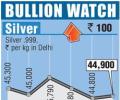
Traders said buying activity emerged for the ongoing marriage season as the metal remained weak in the previous session.

The Indian IPO market is experiencing a significant surge in preliminary filings, with 38 companies submitting papers to SEBI in March 2026, driven by a combination of improved issuer confidence, strategic regulatory compliance, and private equity investors seeking exits amidst volatile market conditions.

Foreign investors have withdrawn over Rs 88,000 crore from Indian equities this month, driven by geopolitical tensions, a weak rupee, and concerns about rising crude oil prices.

The 8th World Air Quality report reveals Pakistan as the most polluted country, with India ranking sixth. The report analyses air quality data from over 9,446 cities across 143 countries, highlighting the severe impact of pollution on global health, especially for children.

The voice of one of India's greatest playback singers may have fallen silent, but her music is anything but gone. It lives on in the airwaves, in our memories, in moments we return to without even realising.

In an unexpected moment, Miss Grand Thailand contestant Kamolwan Chanago handled a sudden on-stage mishap with remarkable composure.

Indian stock market benchmark indices Sensex and Nifty experienced a significant drop in early trade due to rising crude oil prices, bearish global market trends, and continuous foreign fund outflows.

India's residential real estate market experienced a 4 per cent year-on-year decline in sales during Q1CY26, while office leasing reached a quarterly high, rising 6 per cent year-on-year to 29.9 million square feet, according to Knight Frank India.

'Except for extremely conservative investors, others can consider allocating 10 to 20 per cent of their portfolio to small caps.'
Indian markets on Dalal Street rallied sharply as easing tensions in the US-Iran conflict and stable oil prices boosted sentiment. Track Nifty 50 and BSE Sensex performance and key global triggers.

Equity indices slipped in the negative territory on Wednesday after a two-day breather, with the BSE Sensex tumbling 709.54 points following weak trends in global markets. Unabated foreign fund outflows also played spoilsport for the bourses. The 30-share BSE Sensex tanked 709.54 points or 1.35 per cent to settle at 51,822.53. During the day, it declined 792.09 points or 1.50 per cent to 51,739.98.

Which countries possess populations of people with the most self-love?

Prime Minister Narendra Modi met representatives of several prominent American think-tanks on Monday -- his last engagement of the day -- to understand how they look at global trends and challenges and what India and the US can do together for the world.

Reserve Bank of India (RBI) Governor Sanjay Malhotra stated that recent regulatory measures to address foreign exchange market volatility, such as capping banks' net open positions, are temporary and aligned with current market conditions, not signalling any structural shift in policy.

Financial year 2025-26 (FY26) saw a significant shift in corporate fundraising, with rights issues more than doubling to a multi-decade high of 51, raising 44,290 crore, while qualified institutional placements (QIPs) more than halved to 29 issues, mobilising 62,954 crore, driven by sharp equity market corrections and regulatory changes.
